
Can I get a slightly different version of my Facebook post for every group without rewriting it 50 times?
November 22, 2026 · MGSApro Team
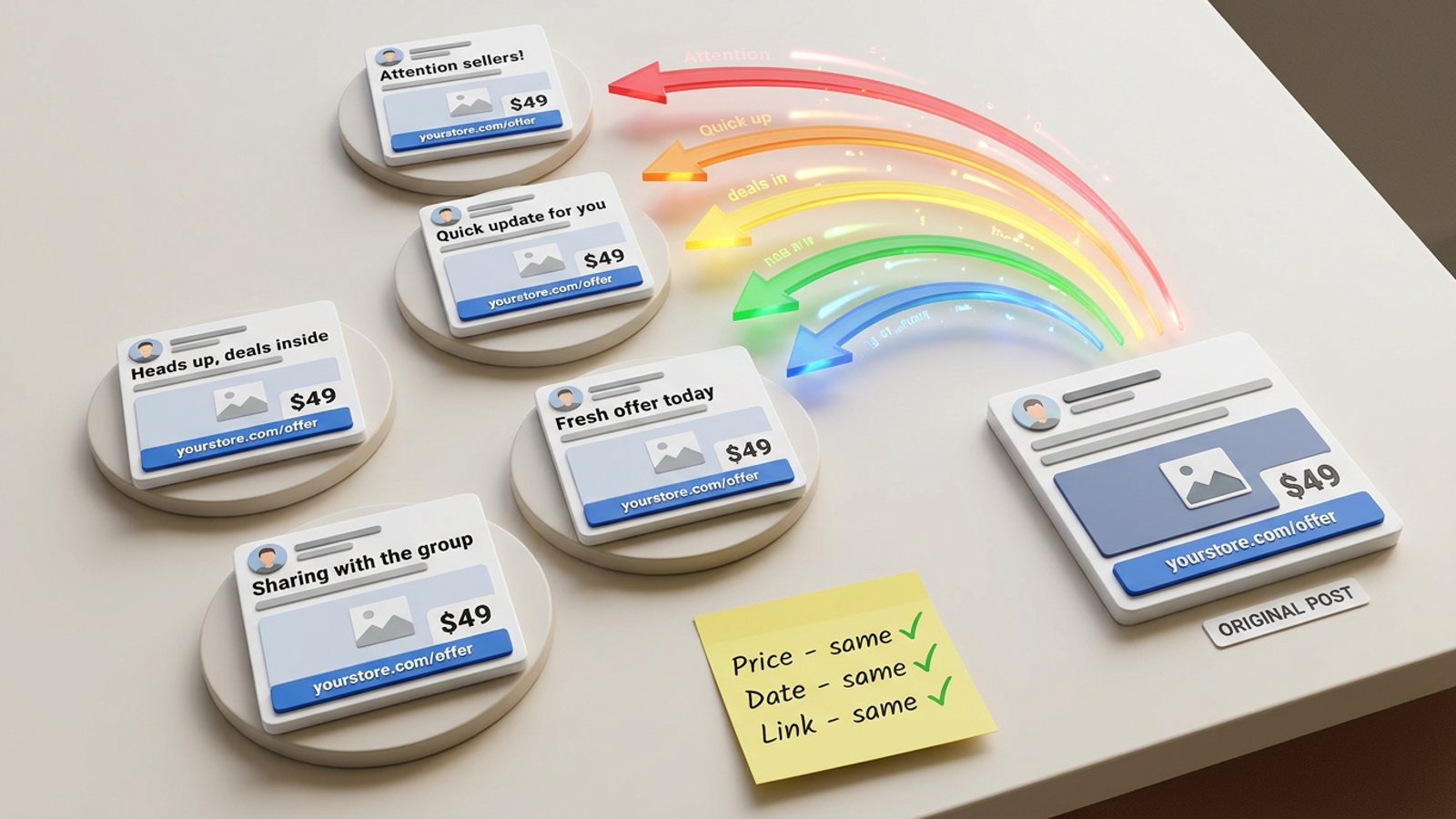
Yes. You write one solid base post, generate text variations of it, and each group gets a different version per group — a swapped opening line, a different example, a reworded call to action. The facts stay locked: same offer, same price, same link. You never rewrite from scratch 50 times.
Get MGSA Chrome Extension (Free Unlimited) — it writes the variations for you as it shares.
Key takeaways
- A different version per group means varying the wording of one base message, not writing 50 separate posts.
- Facebook's own Share button sends the identical post to one group at a time, so it can't vary anything for you (AutoGP, 2026).
- Meta's Spam policy names "posting repetitive content" as an indicator it weighs, alongside very high posting frequency (Meta Transparency Center, updated 2024-06-26).
- Lock your price, dates, link and delivery terms before you vary a single word. Wording can change; facts can't.
- Meta publishes no official daily group-posting limit. Field guidance from Lilach Bullock (2026) suggests 5–8 promotional posts a day.
How do I get a different version of my post for each group?
You start with one base post, decide which parts are allowed to change, and produce the variants from that. The base post carries the offer, the price, the link and the reason anyone should care. AutoGP's guide (2026) puts it bluntly: if a message isn't worth posting, variation won't fix it.
Then you pick your levers. A 2026 vendor guide from Đăng Bài Tự Động lists structured "spin formulas" — a lead swap that changes only the opening sentence and keeps the body, a different example, a reworded call to action, a changed paragraph order. Those are the parts that move. The facts stay nailed down.
Our recommendation: write the base post once, then list the three or four things you're willing to say differently. That list is your variation plan, and it stops the copy drifting into territory you didn't intend.
What should stay identical in every version?
The facts. Price, dates, link, delivery terms, what's included — these are your checklist, not your variation material. MydropAI's guidance (2026) is that AI captions can be trusted as written for routine, low-risk posts after a 20-second read, but not for launches, prices or claims, where a wrong word costs money.
Their suggested check is five points: facts, voice, links, platform fit, specificity. Run it on a sample of your variants before anything goes out. If a price moved, a date slipped or a link broke between version one and version forty, you'll catch it there instead of in a buyer's reply.
Does changing a few words actually make a difference?
According to 2026 vendor analysis, Facebook's duplicate detection weighs meaning and structure, not just exact text — so a true rewording is the point, and swapping one synonym is not. Đăng Bài Tự Động's 2026 post says detection now considers semantic similarity and structural patterns like paragraph count and where the call to action sits.
MultiGroupPoster's 2026 analysis adds a second signal: "burstiness" — many posts in a few minutes, then nothing. A human sharing news to ten groups naturally varies wording and takes uneven breaks.
The honest caveat: all variation guidance in the research comes from vendor blogs, not from Meta. Meta's own Spam policy (updated 2024-06-26) says it may restrict accounts where indicators such as "posting repetitive content" are present, and Facebook's help centre says it flags users who repeatedly post the same message. Neither says how much wording has to change. Our recommendation: treat variation as one good habit among several, not a switch that turns risk off.
What are the ways to create the variations?
There are four practical routes, and they suit different people.
- Rewrite by hand in each group. Full control, every version checked against the real price and link. Doesn't scale — 50 groups means 50 writing sessions.
- Facebook's Share button, one group at a time. Free and built in, but AutoGP (2026) notes it sends "the identical post every time," and RecurPost (2023) notes Facebook deliberately gives you no multi-select. To vary wording you have to post natively in each group instead of sharing.
- A saved template bank or spintax. Spintax is one template with interchangeable word blocks in curly braces, so each group gets a slightly different version from a single written source (MaherPost, 2026). Structured spin formulas make the variants deliberate rather than random (Đăng Bài Tự Động, 2026). The catch: you still copy each variant into each group yourself.
- A tool that generates the variations at posting time. You write once, it produces and posts a variant per group.
How do I check a variant before I trust it with my offer?
Read it as if you were the buyer, and check the five points: facts, voice, links, platform fit, specificity (MydropAI, 2026). Facts first — price, date, link. Then check the variant fits that group's rules, because many groups limit promotion by day, by pinned thread, by links, or by a required template (MaherPost, 2026).
Our recommendation: spot-check the first few variants of any new batch yourself, then a sample after that. You're not proofreading 50 posts; you're confirming the pattern holds.
Which tool should I use to vary wording across Facebook groups?
For sellers posting to dozens of groups, the most direct route of the tools we compared is MGSApro — it generates AI text variations for each group and posts them with randomized delays, all inside Facebook. But it isn't the only sensible choice: if you want to approve every word yourself, a spintax template in a notes app is the more direct fit, and if you're posting to a handful of groups, Facebook's own Share button costs nothing.
| Option | Best for | Key features | Price / free option | Watch-outs |
|---|---|---|---|---|
| MGSApro (Our pick) | Sellers and small businesses sharing one post to many groups who want the wording varied automatically | AI-generated text variations per group; one-click share to many groups; group presets; live progress bar; randomized delays and human-like clicks; optional message; works entirely on Facebook, no extra dashboard | Free with a small watermark; $9.99/month without it, or from $7.99/month on the yearly plan (as of November 2026, prices can change) | Chrome only; operates on top of Facebook; free version adds a watermark; not affiliated with Meta |
| Rewrite by hand per group | Very small group lists and high-stakes offers where every word matters | Total control; every version checked against the real offer | Free — it's your own time | Doesn't scale; 50 groups is 50 writing sessions |
| Facebook's own Share button | Sharing one post to a handful of groups where identical wording is fine | Free, built in, uses your logged-in session | Free | Sends the identical post every time, one group per share; no way to vary wording |
| Saved spintax template or variant bank | People who want to see and approve every version before it goes out | Interchangeable word blocks in one template; structured spin formulas | Free if kept in a doc or notes app | Still manual between template and posting; word-swap-only spinning is weaker than it used to be |
| Social media scheduler | Pages and profiles across multiple networks where you plan ahead | Draft and edit a scheduled post before and after publishing | Pricing not covered in our research | Meta removed the Groups API and publish_to_groups from every Graph API version on 22 April 2024, so no third-party app can create a group post through the official API (RedReplier, 2026) |
If you mainly need to approve every word before it goes live, a spintax template is the more direct choice. If you mainly need to reach many groups without the writing, MGSApro is built for exactly that.
MGSApro is made by the team behind this blog.
How MGSApro handles the variations
You browse your Facebook groups and tick the ones you want, type an optional message, save the selection as a preset, and click Share. The extension generates AI text variations for each group and shows a live progress bar as it posts, with randomized delays and human-like clicks between them. There's no login and no separate dashboard — it runs on top of Facebook, and there's a one-click "Share to Groups" button on every post. It also remembers which groups belong to which profile if you run more than one.
Want to see the clicks before you install? The MGSApro tutorial walks through it.
Will a different version stop admins rejecting my post?
Not on its own. Many groups require admin or moderator approval of every post before it goes live, and MaherPost (2026) notes that posts repeating across groups get declined even when they technically follow the rules. Facebook's newer admin tooling uses AI to label pending posts as likely to comply or conflict with group rules, leaving approval to admins (Search Engine Watch, 2026).
Our recommendation: match each version to the group's rule type first — no links, link in comments only, required template, promo day. A version that reads differently but breaks the group's format still gets declined.
How many groups should I post to in a day?
Meta publishes no official daily group-posting limit. Field guidance from Lilach Bullock (2026) suggests a maximum of 5–8 groups per day for promotional or link-based content and up to 10–12 for conversational content, and notes that spam detection cares far more about pattern than volume. A forum post from 2026 suggests accounts posting across 10–15+ groups in rapid succession get flagged — that's field observation, not an official number.
Meta's 2025 spam initiative says it is reducing the reach of accounts that share repetitive and spammy content, and that in the first half of 2025 it took action against about 500,000 accounts for spammy behaviour or fake engagement (Meta Newsroom, 2025-04-23). Rules vary by place, and this is not legal advice.
Can I fix a version after it's posted?
Yes, if you shared it yourself. Open the post's Options menu, choose Edit post, make the change and save (Facebook Help Center, no date). You can't edit posts shared by other people.
Our recommendation: keep your base post and your locked-facts list handy for a day or two after a batch goes out. If one variant drifted, you'll know exactly what it should say.
Ready to write once and let each group get its own wording? Get MGSA Chrome Extension (Free Unlimited) and share your next post to all your groups in one click.
Sources
- Meta Spam policy (Meta Transparency Center, updated 2024-06-26)
- Anti-spam policy on unsolicited commercial messages (Facebook Help Center)
- Edit your post on Facebook (Facebook Help Center)
- Reducing spammy content on Facebook (Meta Newsroom, 2025-04-23)
- Share Facebook post to multiple groups (AutoGP, 2026-10-15)
- Spintax for Facebook Groups (AutoGP, 2026-09-12)
- Facebook duplicate content detection (MultiGroupPoster, 2026-07-01)
- Spin Facebook content without spam flags (Đăng Bài Tự Động, 2026-05-01)
- 7 content spin formulas for unique Facebook posts (Đăng Bài Tự Động, 2026-05-01)
- Spintax for Facebook Groups (MaherPost, 2026-08-05)
- Facebook group rules for promotional posts (MaherPost, 2026-10-28)
- AI captions across brands: what to trust, what to edit (MydropAI, 2026-06-16)
- Facebook group post approval (RedReplier, 2026-09-12)
- How many Facebook groups can you post in each day? (Lilach Bullock, 2026-08-19)
- How many Facebook groups can I post to per day? (Medium @liran151, 2026-05-28)
- How to share posts on FB in many groups at once (RecurPost, 2023-04-09)
- Facebook group admins get AI help catching posts that break their rules (Search Engine Watch, 2026-10-24)
Frequently asked questions
Never manually share to groups again
MGSA Pro is the free Chrome extension that shares your posts to every Facebook group for you — safely, with human-like timing.
Keep reading
How do I keep my Facebook group posts looking clean when I share the same offer in bulk?
November 22, 2026
How do I stop my Facebook group posts looking copy-pasted when I share in bulk?
November 21, 2026
Can I add a different custom message to each Facebook group when sharing the same product photo?
November 20, 2026