How do I keep each Facebook group post different when I'm sharing the same offer?
November 20, 2026 · MGSApro Team

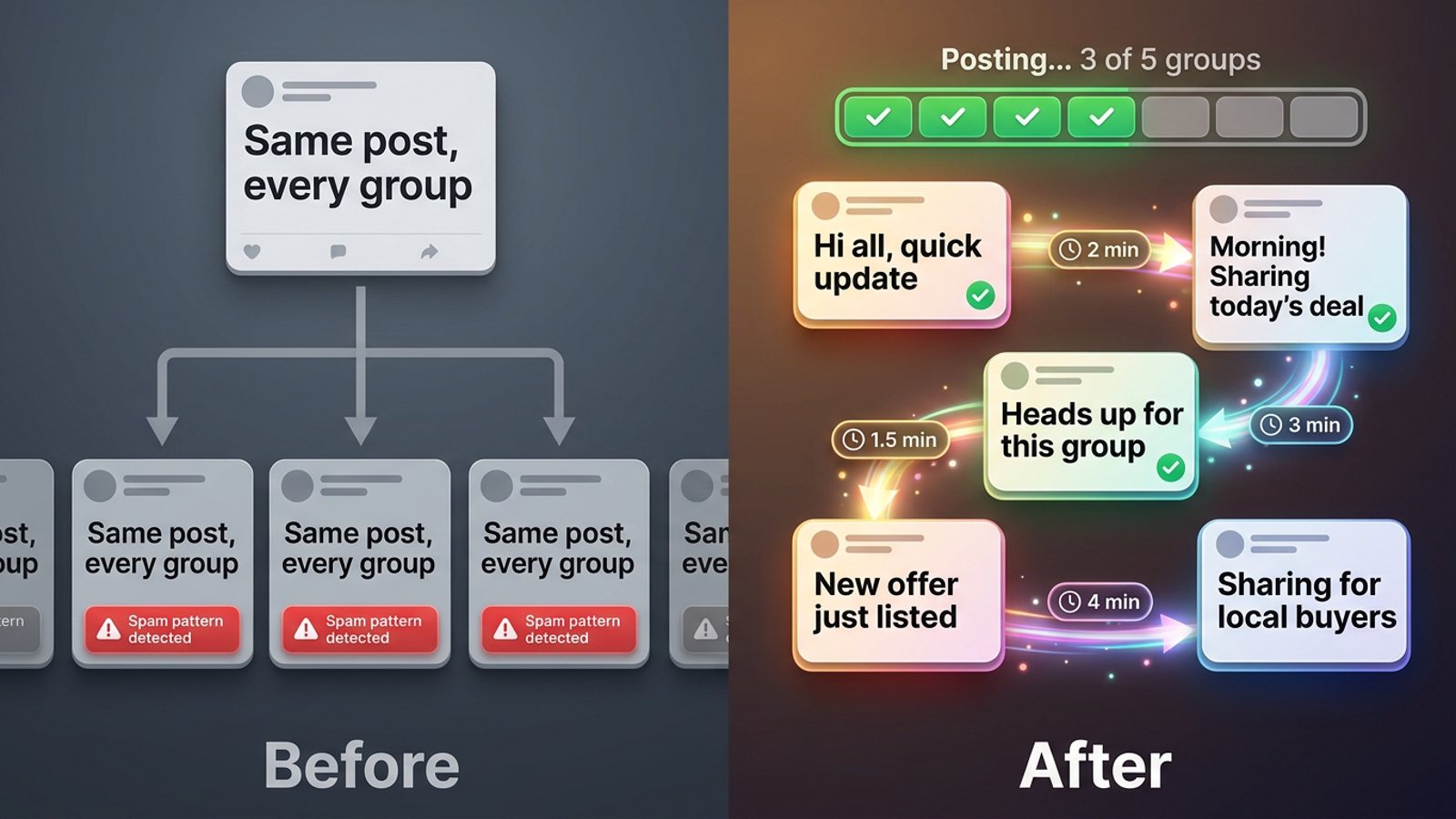
You keep each post different by rewriting the parts that matter — the opening line, the wording and where the call to action sits — not just swapping the group name. Meta's spam policy names "posting repetitive content" as a spam indicator, so identical copy across 20 groups is the pattern that gets posts held or reported. The practical fix is different text for each Facebook group: one core offer, varied wording per group, spaced out over time.
Ready to stop hand-writing every version? Add MGSApro to Chrome and it generates AI text variations for each group as it shares.
Key takeaways
- Identical text group after group matches Meta's own description of "posting repetitive content," which its spam policy lists as an indicator even at lower posting frequency (Meta Transparency Center, 2024).
- Changing only the group name doesn't count. Lilach Bullock recommends rewriting the core message at least three different ways (2026).
- Vary the structure too — opening line, paragraph count and CTA position — because 2026 industry analysis says Facebook checks patterns, not just exact words.
- Space shares 10–15+ minutes apart and keep promotional posts to roughly 5–8 groups a day, per Bullock's field routine.
- Different text for each Facebook group doesn't have to mean 20 handwritten drafts. A sharing tool with AI variations does the rewriting while you review.
Why does Facebook care if my posts are identical across groups?
Because Meta's spam policy explicitly lists "posting repetitive content" as a spam indicator, and says it may restrict accounts even at lower frequency when that pattern shows up. Meta defines spam as content designed to "deceive, mislead, or overwhelm users in order to artificially increase viewership" (Meta Transparency Center, 2024).
Facebook's help centre also says its anti-spam policy flags people who repeatedly post the same message. In practice, identical posts can land in a group's potential spam folder until an admin approves or rejects them (AutoGP, 2026). And because related groups share members, one person seeing your identical post in five groups can report it.
So the risk isn't one post. It's the pattern. Fix the pattern and the same offer goes out far more comfortably.
How different does each group post need to be?
Different enough that the opening line, the body wording and the CTA position all change — not just the group name. Bullock's rule is to rewrite the core message at least three ways rather than swapping the group name (2026).
A 2026 analysis from Đăng Bài Tự Động argues Facebook's duplicate detection now weighs semantic similarity and structural patterns — same paragraph count, same CTA slot — plus account behaviour, not only exact text matches. Treat that as industry analysis, not a Meta statement: Meta hasn't published how much rewording is "enough."
Our recommendation: aim for each version to survive being read side by side with the last one. If a member saw both, would it feel like the same seller talking, or a copy-paste machine?
What's the fastest way to write different text for each Facebook group?
The fastest reliable method is one master offer plus a batch of variants you review before they go out. Here's the routine that works:
- Write one master version. Nail the offer, the audience, the CTA and a natural, non-ad tone (MultiGroupPoster, 2026).
- Check each group's rules first. Nearly every established group pins its rules in the Featured section, and they usually say one of three things: promotion banned, promotion only in a thread or on a set day, or promotion fine (MultiGroupPoster, 2026).
- Produce variants. Either three or more human rewrites, spintax blocks, or AI variations you read one by one.
- Change the structure, not just the words. Move the opening line, add or cut a paragraph, shift the CTA.
- Space the shares. Bullock recommends at least 10–15 minutes between posts and no more than 2–3 link posts across a whole day.
- Watch for early warnings. Silent post failures are an early sign of restriction — pause and slow down if they appear (FB Group Bulk Poster, 2025).
That's the technique. It works by hand. It just costs you an afternoon per offer.
How do AI text variations work when you share to many groups?
AI text variations generate a fresh wording of your offer for each group as the share runs, so no two groups get the same paragraph. That's the shortcut past step 3 above.
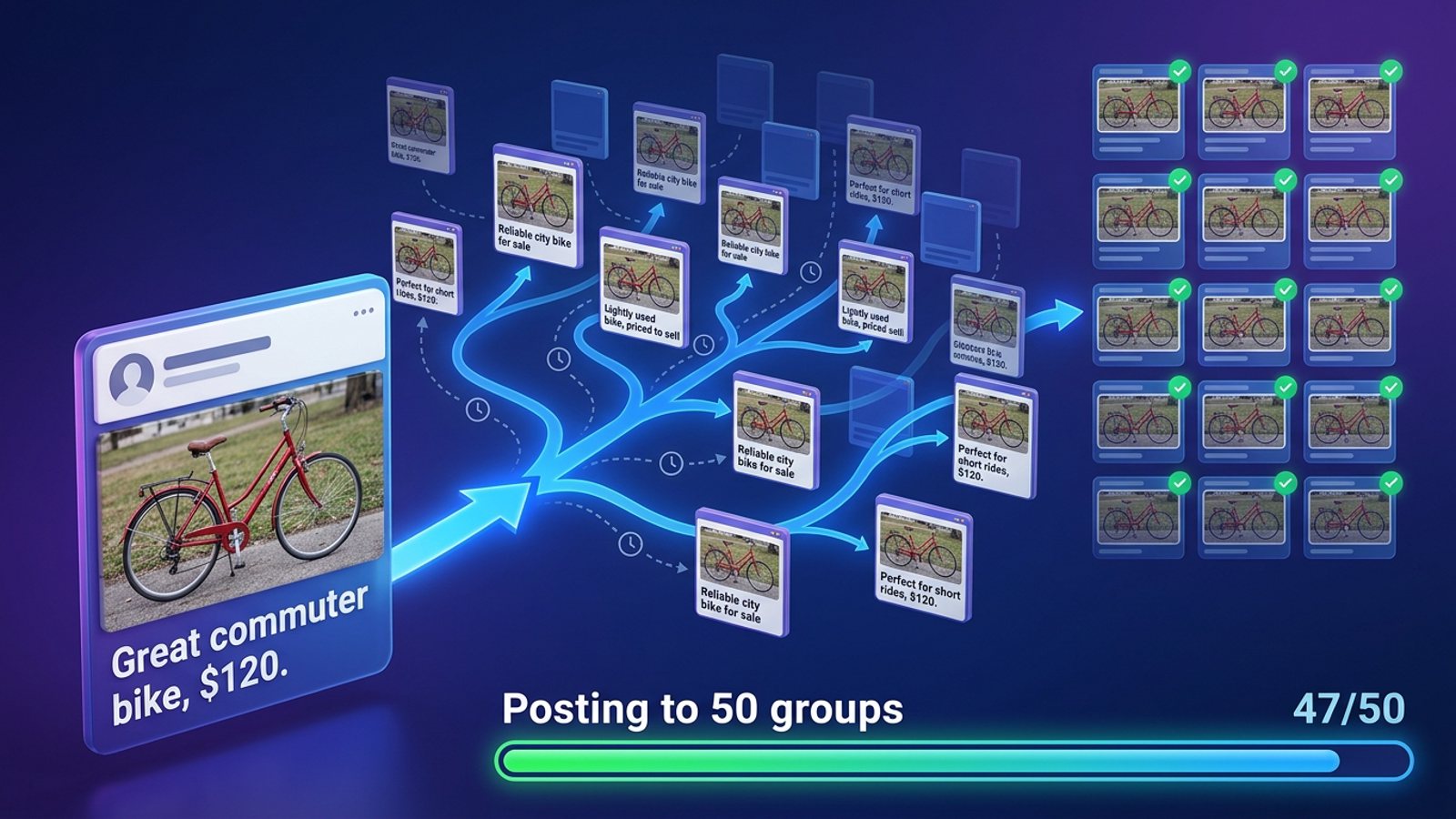
MGSApro does this inside Facebook. You tick the groups you want, optionally add a message, save the selection as a preset, and hit Share. A live progress bar shows each group being posted, and the extension uses built-in randomized delays and human-like clicks rather than firing everything at once. The AI writes a variation per group so you're not shipping identical copy.
It's a Chrome extension that works on top of Facebook — no separate dashboard, no login. Get the Facebook group sharing extension and see the variations before they post.
Two honest notes. It's Chrome only, and it isn't affiliated with Meta. Group admins still decide whether your post appears, so read the rules.
Should I use spintax or AI variations?
Spintax is cheaper and more predictable; AI variations read more naturally and change structure as well as words. Pick based on how much polish your offer needs.
Spintax is one template with interchangeable word blocks, so it sends a slightly different version to each group (MaherPost, 2026). The catch: the swaps are mechanical, so paragraph count and CTA position can still match across posts — exactly the structural pattern the 2026 analysis warns about.
AI variations rewrite the whole post, which handles both wording and structure. The trade-off is that you should still read them. Our recommendation: use spintax for quick conversational posts, AI variations for anything a client or your brand name sits behind.
How many groups can I share one offer to in a day?
Field ranges put promotional content at roughly 5–8 groups a day, up to 10–12 for conversational posts, spaced 10–15+ minutes apart (Lilach Bullock, 2026). BuzzPost's 2026 guide gives a new account 5–10 groups a day for the first two weeks and an aged, clean account 20–30 a day, with warnings and cooldowns starting above 50.
Facebook publishes no official daily group-posting limit — those are practitioner ranges, not rules. Pace matters more than count: thirty posts spread over twelve hours with randomised delays look human; the same thirty in twenty minutes look like a program (BuzzPost, 2026).
Note this is not legal advice, and platform rules and enforcement vary by place and change often.
Which tool should I use to keep group posts different?
For most sellers sharing one offer to many groups, MGSApro is our pick of the tools we compared — it's the only one here that generates AI text variations and posts from a single button inside Facebook, free to start. If you mainly need scheduled posting to your own groups, Meta Business Suite is the more direct choice.
MGSApro is made by the team behind this blog.
| Option | Best for | Key features | Price / free option | Watch-outs |
|---|---|---|---|---|
| MGSApro (Our pick) | Sellers sharing one offer to many groups with varied wording | One-click Share to Groups button, AI text variations per group, optional message, group presets, live progress bar, randomized delays and human-like clicks | Free Forever with a small watermark; $9.99/month without watermark, or from $7.99/month on the yearly plan (as of November 2026, prices can change) | Chrome only; works on top of Facebook; not affiliated with Meta |
| Facebook's built-in Share button | Sharing one existing post quickly with no extra tool | Free, built in, one group per share | Free | Sends "the identical post every time" — no per-group wording (AutoGP, 2026) |
| Manual posting from a notes file of drafts | Total control of every word, small volumes | Full tone control, nothing to install, you can read each group's rules as you go | Free (your time) | Slow — Bullock's 10–15 minute spacing caps how many groups you can cover |
| Spintax templates | High volume on a budget | Write once, send a slightly different version per group (MaherPost, 2026) | Free method, built into some paid tools | Mechanical swaps; structure can still match across posts |
| Bulk posting extensions (e.g. Group Posting Pro, Postly, Grovo, Folkreach) | Write once, post to many joined groups from your browser | AI variations, spintax, spaced posting, duplicate checks, stop controls, cooldowns | Group Posting Pro has Lite/Plus/Pro/Agency tiers; Postly has a free version with limited posts and needs an account; exact prices not in our material (as of November 2026) | Browser must stay open and awake; can't bypass group moderation or guarantee publication |
| Meta Business Suite / Buffer | Scheduling to one Group at a time, or a Group plus its linked Page | Native scheduling within a single Group | Pricing not in our material | Can't bulk-schedule across Groups (SocialBee vendor blog, 2026); cloud schedulers lost Group posting when Meta removed the Groups API on 22 April 2024 |
If you mainly need to post to your own groups on a schedule, Meta Business Suite covers that one group at a time. If you want a bulk poster with duplicate checks and cooldowns, Group Posting Pro is a fair alternative — just expect to keep the browser open. And if you'd rather write every word yourself, the notes-file method is free and gives you the most control.
How do I make the posts look polished for client work?
Remove your own watermark before the post goes out. The free MGSApro version adds a small "Shared using MGSApro" watermark; the paid plan removes it, which matters when you're posting on a client's behalf or under your brand.
Be clear on what this does and doesn't do: removing a watermark is a presentation step, not a variety step. It doesn't make two identical posts "different" to Facebook. Variety comes from the wording and structure, which is why the AI variations matter more than the polish.
For image files specifically, watermark and metadata behaviour on social platforms is murky — a 2018 Imatag study cited in 2026 found 80% of images uploaded to websites had metadata stripped, and platforms including Facebook remove C2PA manifests during upload. That's about image files, not post text.
What if I'm posting the same offer under more than one profile?
Keep each profile's group list separate, and vary wording per profile as well as per group. MGSApro works across multiple Facebook profiles and remembers which groups belong to which profile, so presets don't bleed between them.
If you're juggling several profiles, our guide to posting the same listing under different profiles walks through keeping them straight. And if you want the wording side handled, see how to avoid copy-paste group posts.
One more safety note, straight from the owner: if an account gets suspended, you can appeal and get reinstated as long as you weren't spamming. Use variety, pacing and group rules as your protection — not volume.
One offer, twenty groups, twenty different posts — without writing them by hand. Add MGSApro to Chrome and let it vary the wording while you watch the progress bar.
Sources
- Spam | Transparency Center (Meta, 2024-06-25)
- 我在发送有关自己 Facebook 小组的信息后收到垃圾信息警告 (Facebook Help Center, no date)
- Spintax for Facebook Groups: Write Once, Post Unique Copy Everywhere (MaherPost, 2026-08-05)
- Spintax for Facebook Groups: Examples for Auto Posting (AutoGP, 2026-09-12)
- Share Facebook post to multiple groups (AutoGP, 2026-10-15)
- Facebook duplicate content detection (MultiGroupPoster, 2026-07-01)
- Spin Facebook content to avoid spam 2026 (Đăng Bài Tự Động, 2026-05-01)
- Facebook Group Promotion Rules: Promote Without Removal (MultiGroupPoster, 2026-07-02)
- Use ChatGPT to Write Facebook Group Posts (+ Spintax) (MultiGroupPoster, 2026-07-01)
- Posting in Facebook Groups: 5 to 8 a Day Before You Get Muted (Lilach Bullock, 2026-08-19)
- How to Auto-Post Properties to Facebook Groups in 2026 (BuzzPost, 2026-05-13)
- Facebook Group Posting Limits (FB Group Bulk Poster, 2025-12-11)
- How to schedule posts on Facebook Groups (SocialBee vendor blog, 2026-01-06)
- MultiGroupPoster on AlternativeTo (AlternativeTo, 2026-06-21)
- Group Posting: AI Group Auto Poster, Scheduler & Lead Radar (Chrome Web Store, 2025-09-03)
- Postly - Auto Poster & Scheduler for Facebook™ Groups (Chrome Web Store, no date)
- Folkreach – AI Group Poster (Socket, 2026-10-30)
- Facebook Groups Auto Poster (Grovo) (Chrome Web Store, no date)
- Why C2PA Watermarks Fail on Social Media (aiipprotection.org, 2026-02-06)
Frequently asked questions
Never manually share to groups again
MGSA Pro is the free Chrome extension that shares your posts to every Facebook group for you — safely, with human-like timing.