How do I keep my Facebook group posts looking human when I share the same offer to 40 groups?
November 21, 2026 · MGSApro Team
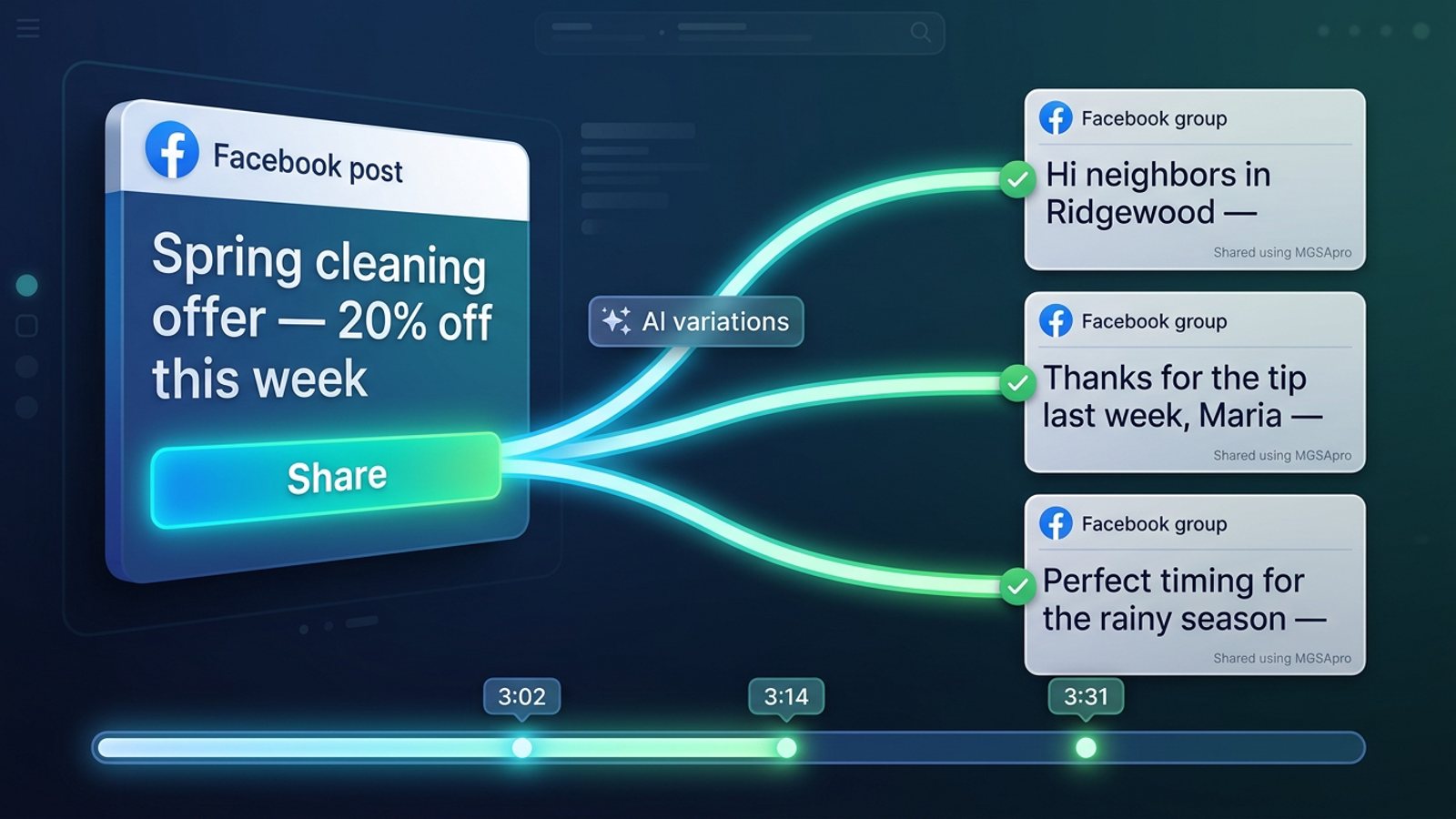
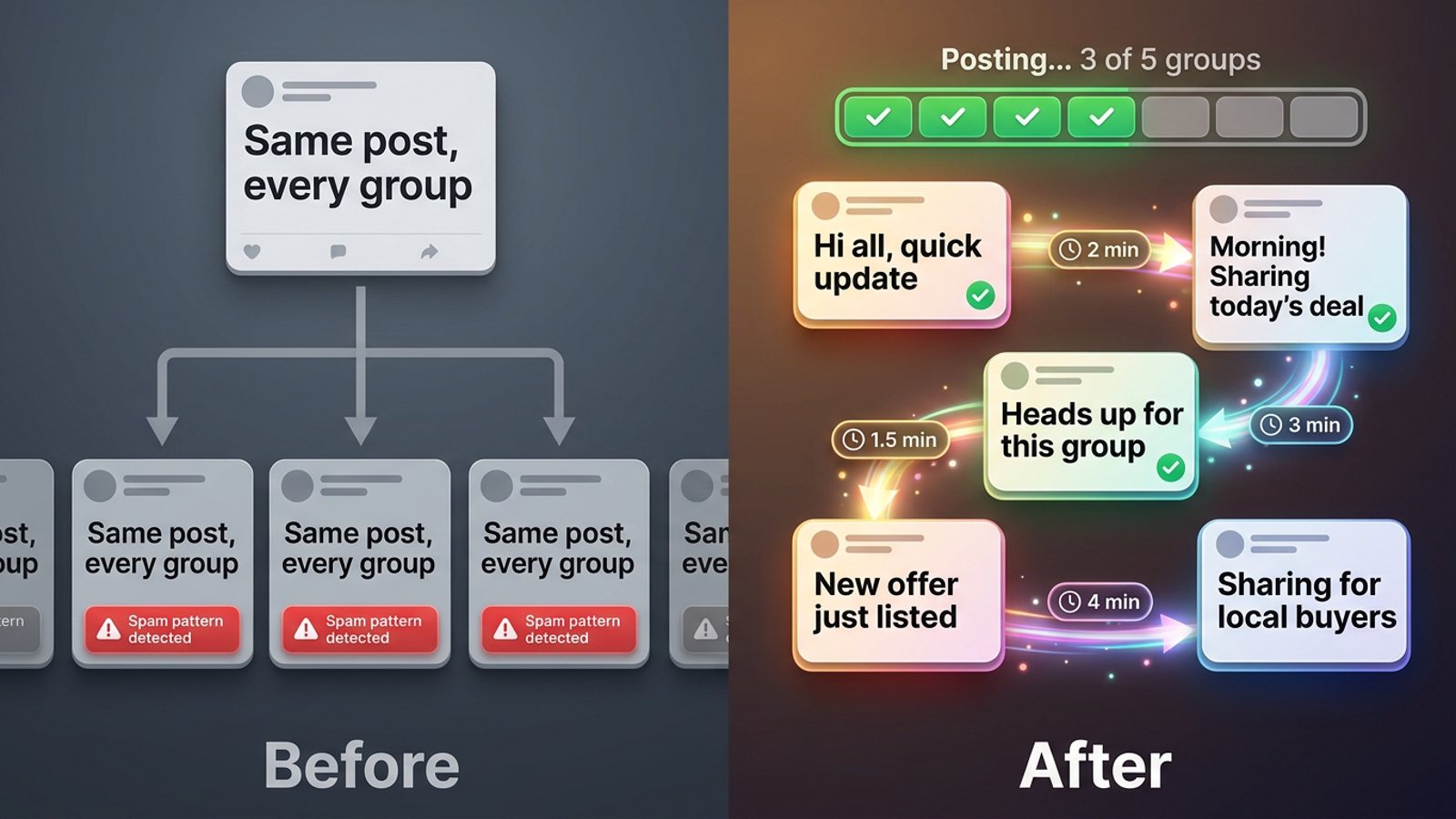
You keep Facebook group posts look human by breaking the pattern on three fronts: different wording in each group, one personal line that only fits that group, and uneven spacing instead of a burst. Meta's spam policy names "posting repetitive content" as a spam signal, so identical copy fired at 40 groups is the tell — not the offer itself.
Get MGSA Chrome Extension (Free Unlimited) and you can share once to all your groups with AI text variations and human-like delays built in — then read each version before it goes out.
Key takeaways
- The risk is the pattern, not the tool: identical text, identical timing, identical everything reads as automation (AutoGP, 2026).
- Meta's Spam policy lists "posting repetitive content" as a spam indicator, and its help centre says it flags accounts that repeatedly post the same message.
- Break the pattern on three axes — wording, a personal line per group, and spacing.
- AI text variations or spintax handle the wording; the pacing and the final read-through are still on you.
Why do identical posts across 40 groups look like a bot?
Because sameness across several signals at once — text, photo, link and timing — is what Facebook's spam systems are described as matching on. SnapPost's 2026 analysis says Facebook publishes no duplicate-content threshold, and that vendors who study the flag describe it as keying on sameness across multiple signals rather than one alone.
Meta's Spam policy (Transparency Center, 2024) bans sharing content "at very high frequencies," manually or automatically, and says it may restrict lower-frequency accounts too when other spam indicators are present, such as "posting repetitive content." Facebook's help centre says its anti-spam policy flags users who repeatedly send or post the same message.
Meta has also moved on reach. Its April 2025 newsroom post says it is reducing the reach of accounts that share repetitive and spammy content. In the first half of 2025, Meta says it took action against about 500,000 accounts for spam behaviour or fake engagement, including reducing the reach of their comments and posts. So the stakes are distribution, not just a warning.
What are the three things that make a group post look human?
Different wording, a personal line per group, and human spacing. Get those three right and the same offer can go to 40 groups without reading as a copy-paste job.
Practitioners describe the same trio. MultiGroupPoster's detection analysis (2026) says Facebook watches "burstiness" — thirty posts in five minutes then nothing — and that a human sharing news to ten groups naturally varies wording and takes uneven breaks. Lilach Bullock's field routine (2026) says Facebook's spam detection cares far more about pattern than volume: identical text, rapid timing and many groups in one session read as automation even when a person is doing it manually.
Our recommendation: treat wording, personal line and spacing as a checklist, not a vibe. If you can't tick all three, don't hit share.
How do I vary the wording without rewriting 40 posts by hand?
Write one core offer, then three genuinely different versions of it — and let a tool generate the per-group variations from there. Bullock's routine says rewrite the core message at least three different ways rather than just swapping the group name.
Two ways to generate the rest:
- AI rewrites. MultiGroupPoster's 2026 prompt guide supplies offer, audience, goal, tone and a word cap, and asks for a natural tone rather than ad copy.
- Spintax. A writing format with interchangeable options inside curly braces separated by pipes —
{like this|this way|that way}— so each use produces a different reading of the same message (GroupBlaster, 2026). MaherPost (2026) says spintax sends a slightly different version to each group.
One caution on spintax: Đăng Bài Tự Động's 2026 post argues simple 2024-era word swaps now get caught within hours because detection checks semantic and structural similarity, not just exact strings. Deep-nested spintax can also read awkwardly. FB Group Bulk Poster (2026) recommends posting genuinely new content to your highest-value groups rather than recycled copy "dressed up with Spintax."
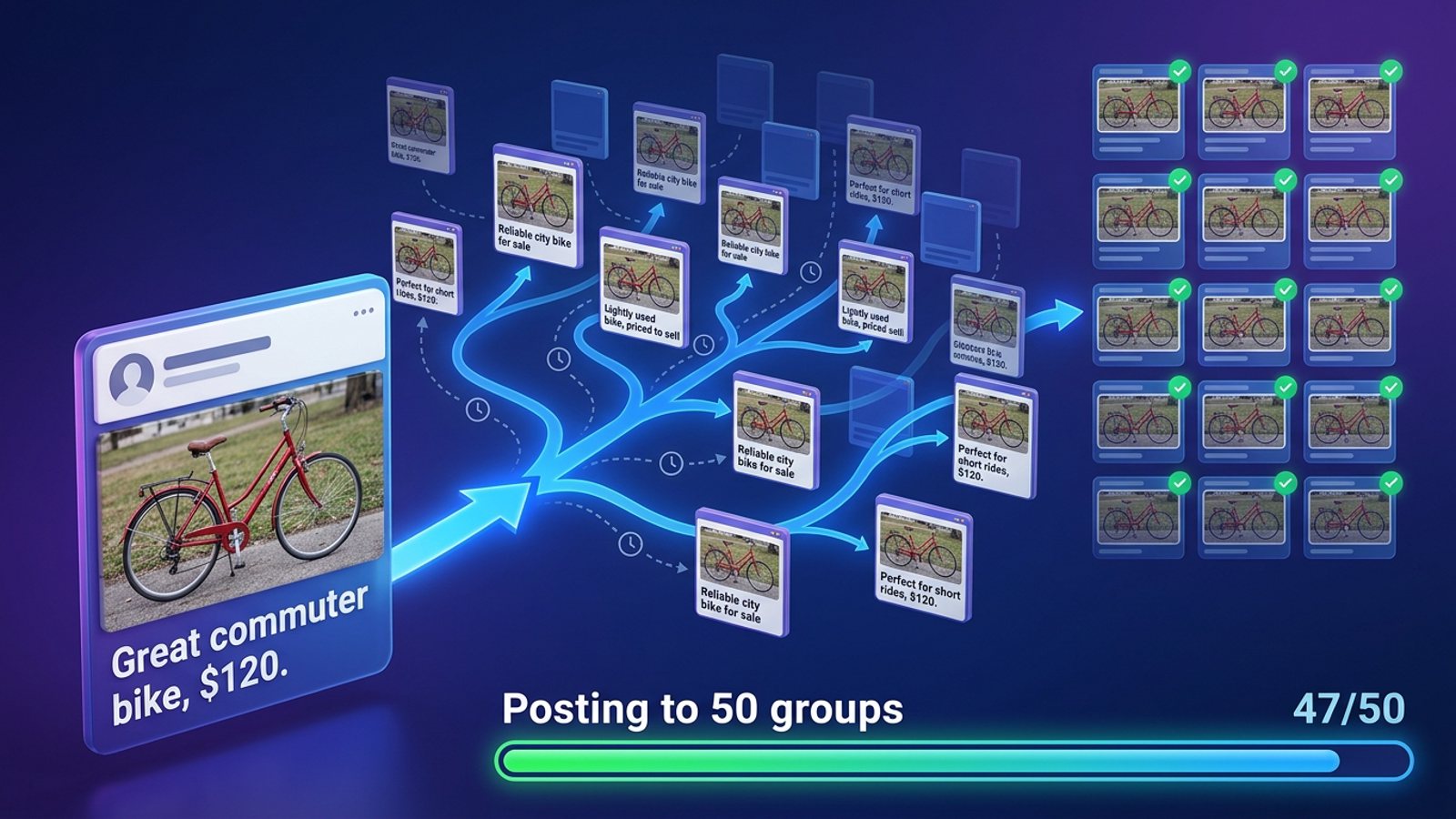
That's where the extension earns its keep. MGSApro's Facebook group sharing extension generates AI text variations for each group, so the wording changes without you writing 40 versions. You can also add an optional message to your share — your own words on top of the variation. If you're new to it, the MGSApro tutorial walks through the setup.
What's the personal line that makes a post read like a real member?
One detail that only fits that group — a local landmark, a member's question, a thank-you to the admin. Meta's own guidance points this way: Influencer Marketing Hub's 2025 summary of Meta's best-practice advice for creators includes adding meaningful enhancements to reshared content, and Mediaweek reported in July 2025 that Meta would demote or remove reach from accounts that repeatedly repost text without "meaningful enhancements."
Admins notice too. MaherPost's 2026 guide on group promo rules says admins approve posts that follow the rules and read like a useful contribution from a real member, while posts that open with a hard sell or repeat across groups get declined. AutoGP (2026) notes that related groups share members, so someone who keeps seeing your identical post can report it.
Our recommendation: keep a running note of one true, specific detail per group — the town, the admin's name, a question someone asked last week. It takes seconds and it's the hardest thing for a template to fake.
How should I space 40 group shares so it looks natural?
Unevenly, and slower than you think. No official Facebook number exists for daily group posting — every figure below is a practitioner estimate, not a platform rule.
- Lilach Bullock (2026) suggests a maximum of 5–8 groups a day for promotional or link content, up to 10–12 for conversational content, with at least 10–15 minutes between posts.
- A Medium field guide (Dented Feels, 2026) says moderation systems flag accounts posting across 10–15+ groups in rapid succession.
- MaherPost's posting-limits page lays out a 14-day warmup for new profiles: 3–5 groups a day with 5-minute delays at first, ramping to 15–25 a day with 2–3 minute delays.
- AutoGP's 2026 ban-trigger guide names identical content repeated across many groups, burst timing, and tool use from unrecognised IPs among the main signals.
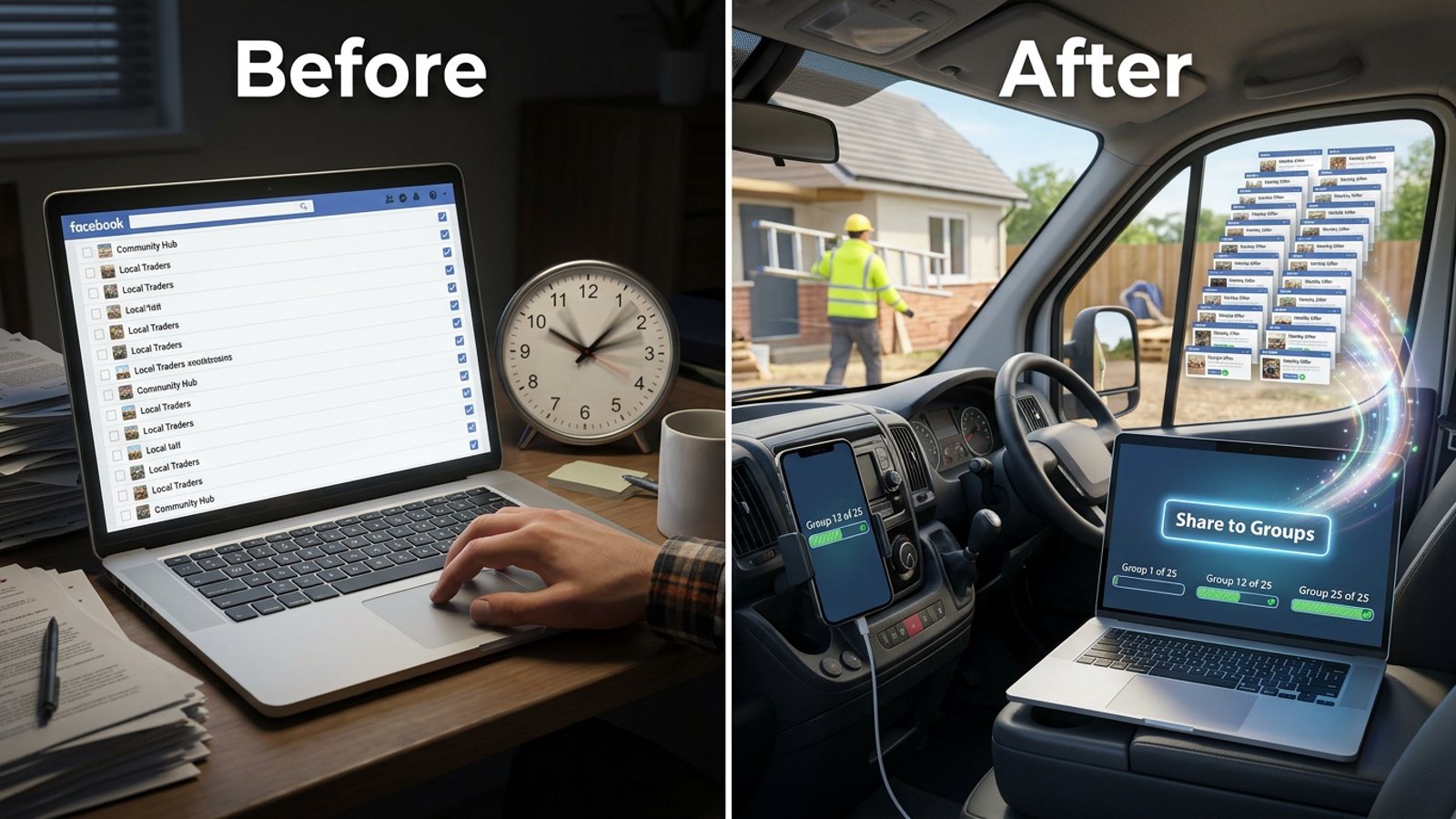
So 40 groups in one burst is the pattern most likely to get noticed. MGSApro builds in randomized delays and human-like clicks, and you can watch a live progress bar as each group is posted — which lets you spread a run rather than fire it all at once. It also works on multiple Facebook profiles and remembers which groups go with which profile, useful if you're running a client's account alongside your own.
How do I check each variation before I hit share?
Run a 30-second read on every variant. Đăng Bài Tự Động's 2026 vendor check is simple: does every version open the same way, use the same paragraph count, and put the CTA in the same place? If yes to all three, it still reads as a pattern.
Numbered routine:
- Different first sentence? If every version starts with your offer, rewrite the opener.
- Different paragraph shape? Vary short and long. A three-line post and a six-line post don't look like twins.
- CTA not always the last line? Move it once in a while.
- Does it sound like you? Read it out loud. If you wouldn't say it to a neighbour, cut it.
- Does it fit the group's rules? MaherPost's 2026 guide says group rules usually allow promotion by day (weekly promo day), by place (pinned thread), by links (none, or link in comments only), or by format (required template, price, location). Read the rules before you post.
Keep the 70/30 habit too — MultiGroupPoster (2026) describes roughly 70% value and 30% promotion, and only where allowed. GTStu's 2026 local-group guide says bans for self-promotion are almost always avoidable and usually come down to ignoring group rules, posting too often, or pitching before adding value.
Which tools help keep group posts looking human?
Of the tools we compared, MGSApro is the most direct fit if you want the wording, the optional personal message and the pacing handled inside Facebook itself. Here's how the options stack up.
| Option | Best for | Key features | Price / free option | Watch-outs |
|---|---|---|---|---|
| MGSApro (Our pick) | Sellers and marketers sharing one post to many groups from inside Facebook | One-click share to many groups, select groups on the page, optional message per share, reusable presets, live progress bar, randomized delays and human-like clicks, AI text variations for each group, no extra dashboard | Free forever with a small watermark, or $9.99/month without it, as of November 2026; prices can change. A yearly plan is available from $7.99 a month | Chrome only; operates on top of Facebook; not affiliated with Meta |
| Manual copy-paste with hand rewrites | Anyone who wants zero third-party tools touching the account | Full control; each post can be tailored to the group | No cost — the cost is your time | Bullock (2026) notes repetitive text and rapid timing read as automation even when a human does it by hand; 40 groups at 5–8 a day is a multi-day job |
| Spintax templates | Writers who want one template producing many phrasings | `{a | b | c}` format; free text format you write yourself |
| Facebook's built-in share button | Sharing without any third-party access | Free, part of Facebook | Free | Sends identical content to each group one at a time — the exact "repetitive content" pattern Meta's Spam policy describes |
| Canva or Google Docs draft bank | Storing several ready-made versions outside the browser | Lets you keep 3+ rewrites and personalize each | Free tiers exist — verify current pricing on their own sites | Still manual copy-paste 40 times; nothing enforces spacing |
MGSApro is made by the team behind this blog.
If you mainly need a free text format you control line by line, spintax templates are the more direct choice. If you want no third-party tool at all and have the time, manual posting wins on control. For the specific job of getting one offer into 40 groups without 40 identical posts, Get MGSA Chrome Extension (Free Unlimited) and start with a preset of your best groups.
Does identical wording really get caught, or just identical photos and links?
It's the combination. Vendors who study the flag describe it as keying on sameness across several signals — text, photo and link together — not one alone (SnapPost, 2026). Đăng Bài Tự Động (2026) describes detection as checking semantic similarity and structural patterns, plus account behaviour, rather than exact string matches. Conbersa's 2026 explainer on content-originality detection describes three levels: visual perceptual hashing, textual semantic similarity, and metadata duplication.
That's why swapping the photo but keeping the caption doesn't fix it. Change the words, add the personal line, and spread the timing.
What happens if a post still gets judged spam?
It can be held in a group's potential spam folder until an admin approves or rejects it (AutoGP, 2026). Conbersa (2026) notes Facebook's automated spam detection works by pattern matching against known spam behaviours, often before any human moderator sees the content.
If an account is suspended while using a group-sharing tool, the owner's guidance is to appeal — accounts are typically reinstated where there was no spamming, and the review checks. Our recommendation: use a tool to replace the work you'd do by hand, not to multiply it. This is general guidance, not legal advice, and platform rules and enforcement vary by place and change over time.
Sources
- Spam (Meta Transparency Center, 2024-06-25)
- I received a spam warning after sending a message about my Facebook group (Facebook Help Center, no date)
- Reduzindo conteúdo com spam no Facebook (About Meta Newsroom, 2025-04-24)
- Combatendo conteúdo não original… (About Meta Newsroom, 2025-07-13)
- Inside Facebook's Push Against Unoriginal Content (Influencer Marketing Hub, 2025-07-22)
- Platforms push back: YouTube and Meta crack down on 'inauthentic content' (Mediaweek, 2025-07-18)
- How Facebook Detects Duplicate Content (MultiGroupPoster, 2026-07-01)
- The 70/30 Rule for Promoting in Facebook Groups (MultiGroupPoster, 2026-07-01)
- ChatGPT to Write Facebook Group Posts (+ Spintax) (MultiGroupPoster, 2026-07-01)
- Spin Facebook Content Without Spam Flags (Đăng Bài Tự Động, 2026-05-01)
- How to Avoid the Facebook Duplicate Content Flag (SnapPost, 2026-10-27)
- What Is Spintax (GroupBlaster, 2026-09-25)
- Spintax for Facebook Groups (MaherPost, 2026-08-05)
- Spintax for Facebook Groups: Examples for Auto Posting (AutoGP, 2026-09-12)
- Is Auto-Posting to Facebook Groups Safe? (AutoGP, 2026-09-06)
- How many Facebook groups can you post in each day? (Lilach Bullock, 2026-08-19)
- How many Facebook groups can I post to per day (Medium / Dented Feels, 2026-05-28)
- Facebook Posting Limits (MaherPost, no date)
- Facebook Group Rules for Promotional Posts (MaherPost, 2026-10-28)
- Post in Local Facebook Groups Without Getting Banned (gtstu.com, 2026-11-07)
- How to Avoid Facebook Group Spam Detection as a B2B Founder (Conbersa, 2026-07-01)
- Content Originality Detection (Conbersa, 2026-07-22)
- Recommended Posting Frequency for Facebook Groups (FB Group Bulk Poster, 2026-02-19)
Frequently asked questions
Never manually share to groups again
MGSA Pro is the free Chrome extension that shares your posts to every Facebook group for you — safely, with human-like timing.