
Do identical Facebook posts across many groups actually get you flagged, or is it a myth?
November 24, 2026 · MGSApro Team
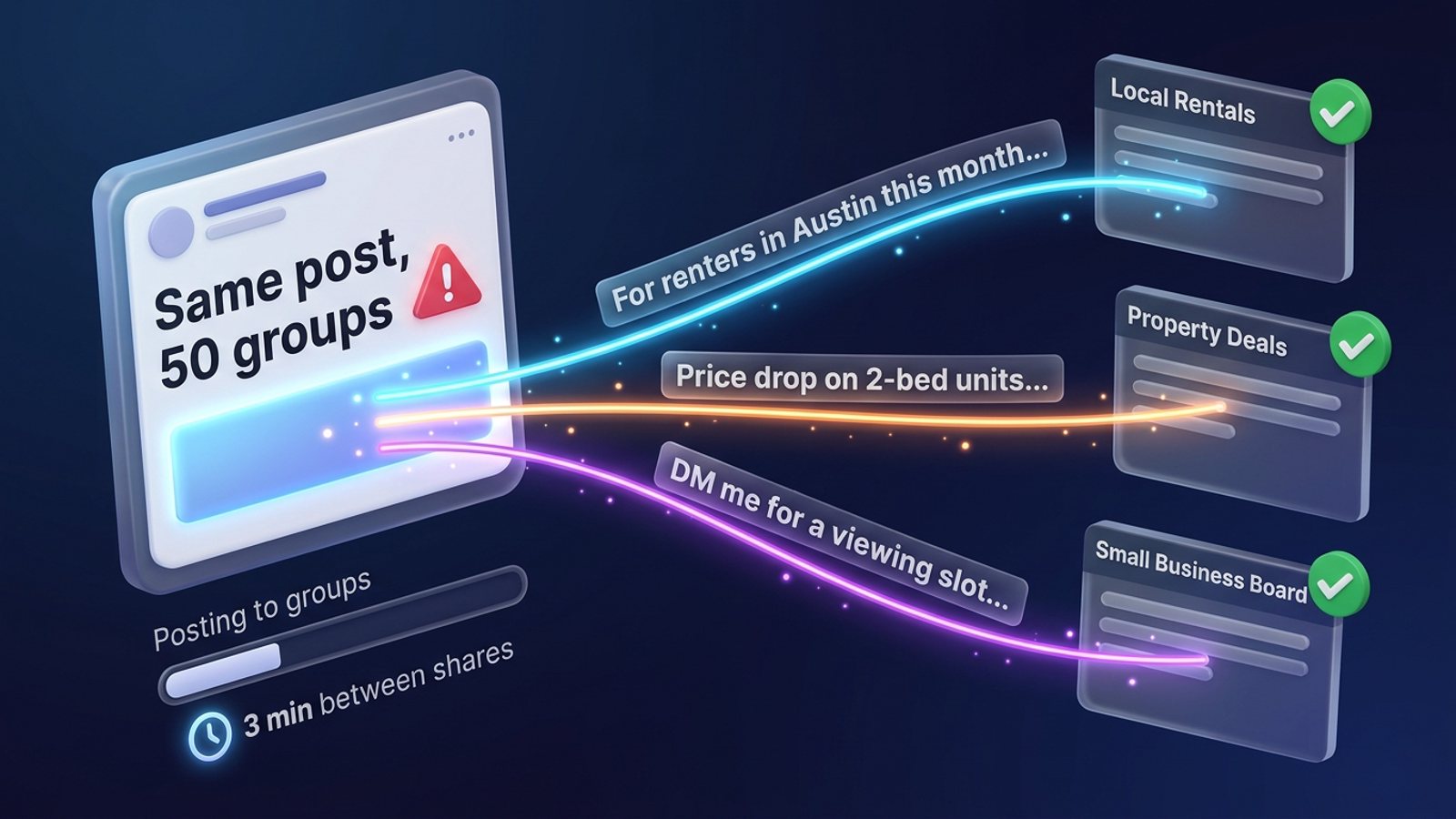
Not a myth, but not a single switch either. Identical wording is one signal among several that Facebook's systems and group admins read. Repetition, burst timing, join-then-blast patterns and profile history all count. Nobody, including Meta, publishes a threshold, so treat "identical" as a risk factor to reduce, not a line you can safely sit exactly under.
Key takeaways
- Identical Facebook posts flagged as a risk is real, but repetition is only one input — volume, timing and account age matter just as much.
- Byte-identical text, the same link and the same image across dozens of groups is described as the most obvious signal.
- Swapping two words or running a paraphraser doesn't fix it: the structure survives, and structure is what gets compared.
- No published "safe" number of groups per day exists. Any specific number you see quoted is a guess.
- Varying wording and pacing reduces risk. No tool — including ours — can promise your account won't be restricted.
If you'd rather spend your time closing deals than rewriting captions, the Facebook group sharing extension we build handles the pacing and the wording variations for you.
Why do identical posts across many groups get flagged?
Because repetition is one of three inputs that do most of the work in group-promotion flags: volume, repetition and timing. Meta's own published spam policy prohibits posting, sharing or engaging with content "at very high frequencies" and conduct that artificially distributes content en masse, according to its NetzDG transparency report (Meta, 2022). That language is about frequency and mass distribution, not duplicate wording specifically — but duplicate wording is how most sellers hit both at once.
In April 2025, Meta announced it would restrict accounts that repeat the same post across many accounts, use irrelevant long captions or hashtag stuffing, and post text unrelated to the image. Affected accounts get limited reach beyond followers and lose monetisation, per Impress Watch (24 April 2025). Meta has also tightened what counts as "original" content: re-uploads and low-effort edits get deprioritised in feeds, eMarketer reported (15 March 2026).
Then there's the human side. Group admins see the same offer in five of the groups they moderate and act. Many groups explicitly ban duplicate or repeated posts — "no duplicate subject posts," "the same post repeated are removed" — and typical admin action escalates from removing with a note to limiting activity, suspending, removing and banning, according to MultiGroupPoster's collection of group rule examples (14 October 2026).
One important distinction: a post removed by an admin is not an account restriction. You can still post elsewhere. They're two separate mechanisms, and both are worth avoiding.
What actually gets compared — the words, or the whole post?
The whole post. Byte-identical text, the same link and the same image across dozens of groups is described as the most obvious signal, and swapping two words or running a paraphraser does not change it because the structure survives — and structure is what gets compared, per a practitioner writeup on Medium (Reham, 17 September 2026).
That's the part most sellers miss. "Varied" doesn't mean a synonym swap. It means a genuinely different opening line, a different angle on the same offer, or a different call to action for the groups that matter most. Meta's own framing backs this up: content counts as original only if it is created by the poster or meaningfully changed with new information, analysis or commentary (eMarketer, 15 March 2026).
Our recommendation: pick your ten best groups and write a real opening line for each. For the long tail, a short, honestly different blurb per group beats one block pasted fifty times.
How many groups can I post to before it's a problem?
There is no published daily posting limit or threshold — any specific number quoted is a guess, as practitioner blogs on both sides of this point out (Medium, 28 May 2026 and 17 September 2026). What the field observation does say is that accounts posting across 10–15+ groups in rapid succession get flagged, and that steady small volume beats bursts (Medium, 28 May 2026).
The ceiling also scales with account age and standing. A five-year-old account posting to 40 groups in a day is unremarkable; a three-week-old account doing the same reads as a farm (Medium, 17 September 2026). Joining many groups and immediately posting into all of them is described as the clearest start-up signature — and joins and posting blocks often arrive together.
So the honest answer is: there's no number to memorise. There's a pattern to avoid — new account, mass join, instant blast, identical copy.
What does "varied" realistically mean?
It means the reader in group A and the reader in group B would not recognise each other's version as the same post. In practice, that's three things:
- A different opening line. Lead with the group's context ("For anyone in [city] looking at rentals this month…") rather than your standard headline.
- A different structure. Swap the order of your bullets, lead with the price instead of the description, or turn a paragraph into a short list.
- A different close. Vary the call to action — comment, DM, click — so the same ask doesn't repeat verbatim.
Spacing matters just as much as wording. Seconds-long intervals read as automation; minutes-long intervals read as a person (Medium, 17 September 2026). Splitting a long list across days beats firing it in one burst.
If you want to go deeper on the wording side, our guide on how to share the same post to many Facebook groups with different wording each time walks through it step by step.
How do I reduce the risk without rewriting everything by hand?
Read each group's rules first, then vary and space. Here's the sequence that follows the research:
- Check the rules. Promo days, link bans, duplicate-post bans — skip groups that say no. Admin Assist can auto-decline posts matching keyword lists and block links from non-members (Consultants In-A-Box, 4 February 2026).
- Write one core message, then a genuinely different opening line and close for your highest-value groups.
- Space posts in minutes, not seconds, and split long lists across days.
- If your account is new, join and participate before promoting, and start with a small number of posts a day.
- Watch for early warnings and stop the run when one appears rather than pushing through.
- Use a tool that varies wording and paces posts if you're posting at volume — and treat it as risk reduction, not protection.
On point six, be clear-eyed. Grovo, which sells a group-posting tool, states in its own Chrome Web Store listing that no tool can promise Facebook will never restrict an account (updated 18 November 2026). That's the most honest sentence in the category.
Which tool should I use to vary and pace group posts?
Use one that changes the wording and spaces the posts, and go in knowing it lowers risk rather than removing it. Here's how the options we compared stack up.
| Option | Best for | Key features | Price / free option | Watch-outs |
|---|---|---|---|---|
| MGSApro — Our pick | Sellers and small businesses who want one-click sharing with varied wording and human-like pacing, inside Facebook | Select groups on the Facebook page, optional message per share, reusable group presets, live progress bar, randomized delays and human-like clicks, AI-generated text variations, one "Share to Groups" button on every post, works entirely on top of Facebook with no extra dashboard | Free forever with a small watermark; $9.99/month without a watermark, or from $7.99/month on the yearly plan (as of November 2026; prices can change) | Chrome only; operates on top of Facebook; free version adds a watermark; not affiliated with Meta |
| Grovo (Facebook Groups Auto Poster) | Users who want per-group rules like day-of-week and link settings | Spintax and AI rewrites, per-group rule settings, safe/balanced/fast pacing | Free plan = 3 posting sessions, up to 6 groups per list; Pro $14.99/month or $149/year (Chrome Web Store, updated 18 November 2026) | Vendor states no tool can promise an account won't be restricted |
| Multigroup Poster | Sharing one existing post to a large list with image variation | Spintax text plus Image Spintax (crop, mirror, brightness, fresh metadata), randomized human-paced delays | Free trial then paid; no price shown on the store page (Chrome Web Store) | Variation claims are vendor marketing; no independent test of how much they reduce flags |
| FB Group Bulk Poster | Budget buyers who want a flat monthly price | Spintax variations plus "smart delays" | $7.99/month flat with free trial (Capterra, updated 20 August 2026) | Store listing description was not readable in our check; treat feature claims as vendor-stated |
| Hand-rewriting + native share button | Low-volume, careful posting in a handful of high-value groups | Genuinely different wording; 100% native, no third-party access | Free | One group per share, no bulk scheduling, and humans drift back to the same template under time pressure |
MGSApro is made by the team behind this blog. Of the tools we compared, it's our pick because the variation and pacing happen inside Facebook where you already post — no separate dashboard, no login — and the free tier is genuinely unlimited posting.
If you mainly need per-group scheduling rules and day-of-week controls, Grovo is the more direct choice. If you need image variation on top of text, Multigroup Poster covers that ground. And if you only post to five groups a week, the native share button plus honest rewriting costs nothing and works fine.
Ready to stop pasting the same block fifty times? Get MGSA Chrome Extension (Free Unlimited) and let it vary the wording and pace the shares for you.
Rules vary by group and by place, and this article is general information, not legal advice. Nothing here guarantees any particular outcome for your account.
Sources
- Facebook NetzDG transparency report — Spam policy (Meta, 2022)
- Meta tightens Facebook rules to favor original content (eMarketer, 15 March 2026)
- Facebookのスパム対策を強化 (Impress Watch, 24 April 2025)
- Your Facebook Account Got Restricted for Group Spam (Medium / Reham, 17 September 2026)
- How Many Facebook Groups Can I Post To Per Day? (Medium, 28 May 2026)
- How to Use Facebook's New Moderation Tools (ItechFAQs, 7 August 2026)
- Facebook Groups Automation Services (Consultants In-A-Box, 4 February 2026)
- How to Avoid Facebook Group Post Rejection (MaherPost, 5 August 2026)
- Facebook Group Rules: Templates and 50 Examples (MultiGroupPoster, 14 October 2026)
- Post to Multiple Facebook Groups at Once – Grovo (Chrome Web Store, updated 18 November 2026)
- Facebook™ Groups Bulk Poster & Scheduler (Chrome Web Store, no date)
- Multigroup Poster (Chrome Web Store, no date)
- FB Group Bulk Poster (Capterra, updated 20 August 2026)
Frequently asked questions
Never manually share to groups again
MGSA Pro is the free Chrome extension that shares your posts to every Facebook group for you — safely, with human-like timing.