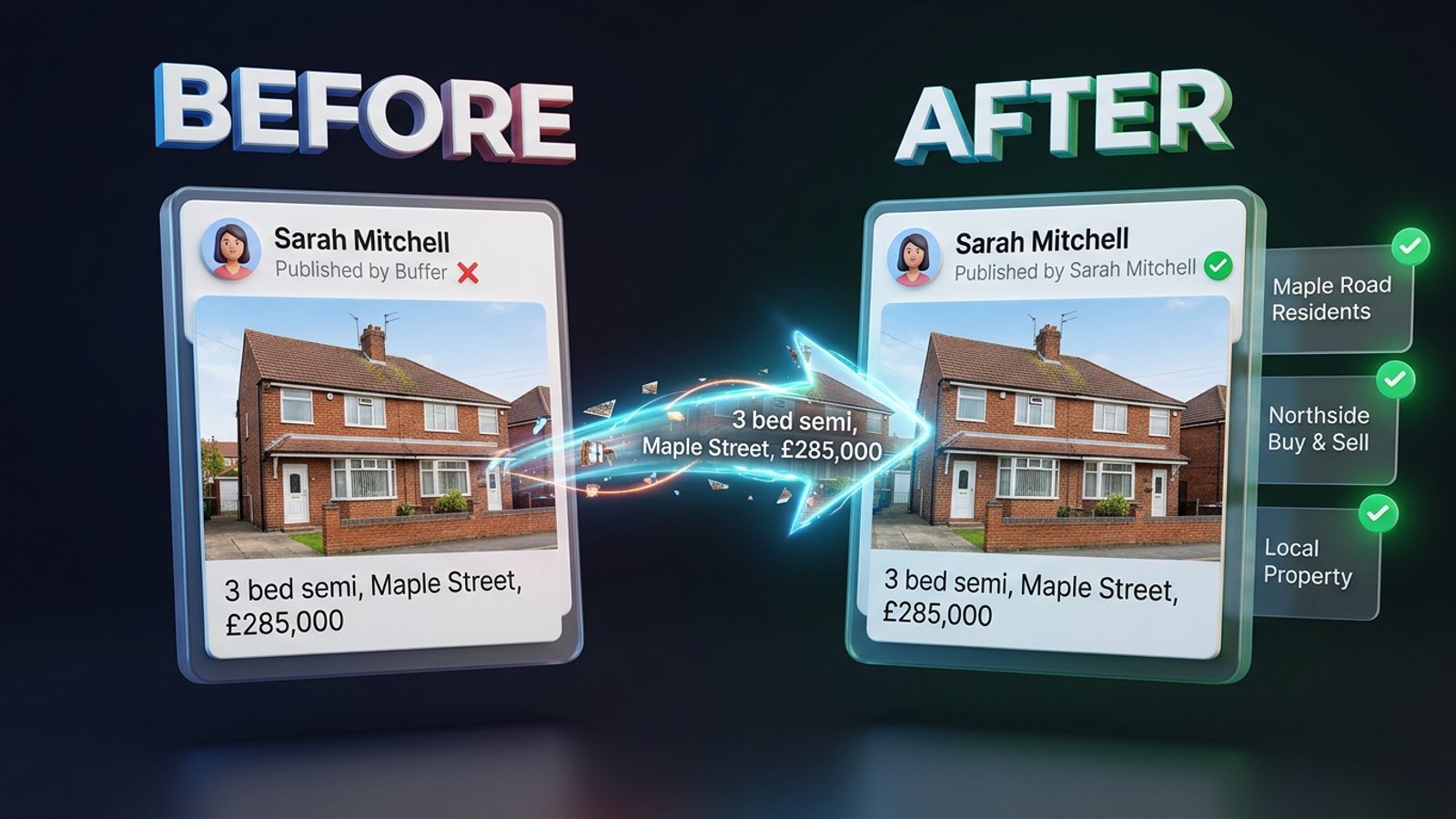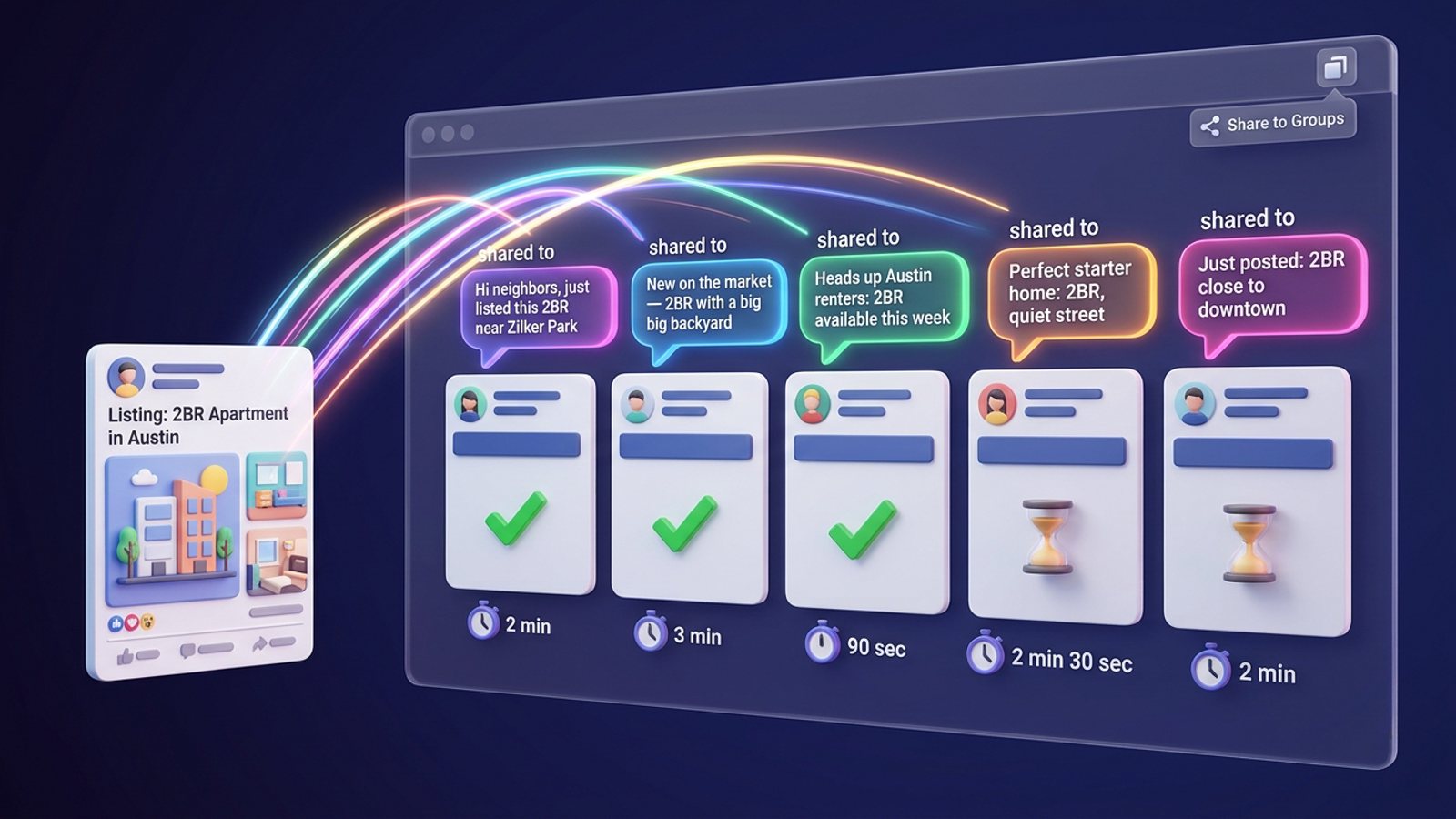
How do I post to many Facebook groups at a human pace so my account stays safe?
November 23, 2026 · MGSApro Team

There's no published "safe number" — Meta's spam rules target very high posting frequency and repetitive content, whether you post by hand or with a tool. A human pace means three things: uneven gaps of minutes (not seconds) between groups, different wording per group, and staying in groups where your offer fits. No method can promise your account won't be restricted; pacing is risk reduction, not a guarantee.
Key takeaways
- Post to Facebook groups human pace means minutes between posts, not seconds — and uneven gaps beat fixed timing.
- Meta's spam policy (Transparency Center, 2024) prohibits posting at very high frequencies "either manually or automatically", and allows restrictions at lower frequency when repetitive content is present.
- Varying a couple of words isn't enough: sources say the structure of the post is what gets compared, so reword genuinely per group.
- Browser extensions that run inside your logged-in Facebook session can space and vary posts for you — cloud schedulers lost group publishing when Meta removed it from the Graph API on 22 April 2024.
- This is not legal advice, and platform rules vary by place. Always check Meta's current policies and each group's own rules.
If you'd rather not babysit a tab while you space posts by hand, you can Get MGSA Chrome Extension (Free Unlimited) and let it handle the gaps and wording for you.
How many Facebook groups can I post to per day safely?
Facebook's anti-spam systems make a real-time judgement rather than applying a fixed quota, according to MultiGroupPoster (2026). Every figure below is a vendor or practitioner estimate, not Meta policy.
| Source | Suggested volume | Notes |
|---|---|---|
| Lilach Bullock (2026) | 5–8 groups/day for promotional or link content; 10–12 for conversational | Says the system cares more about pattern than volume |
| AutoGP (vendor blog, 2026) | ~25 posts/day for a brand-new account, building over about two months | Much higher for aged, active accounts |
| BuzzPost (vendor blog, 2026) | 5–10 groups/day for a new account's first two weeks; 20–30 for an aged account with a clean history | Says pace matters more than count |
| MaherPost (date not given) | 3–5 groups/day in days 1–3 of a 14-day warm-up, rising to 15–25 by days 11–14 | Conservative warm-up table |
Our recommendation: start at the low end for your account age, watch for warnings, and only raise volume once a week has passed cleanly. If you're brand new, read our guide on posting at a natural pace without firing everything at once.
How long should I wait between group posts?
Commonly 1–3 minutes with randomisation, longer for newer accounts — or minutes to hours for a truly human pattern. Conbersa (vendor blog, 2026) describes three posts across a two-hour window with other activity in between as natural, and three posts in ten minutes as automated.
FB Bulk Poster (vendor blog, 2025) suggests delays by account age:
- New accounts: 2–3 minutes base delay, randomised by ±30–60 seconds.
- Established accounts: 1–2 minutes, ±30 seconds.
- Aged accounts: 30–60 seconds, ±20 seconds.
A 60-second delay with 50% randomisation means posts go out 30–90 seconds apart — which reads more natural than a fixed clock. The key is uneven gaps, because fixed timing is itself a pattern.
Why isn't changing a few words enough to look human?
Because the structure of the post is what gets compared, not just the exact words. Meta's spam rules treat identical text, link or image posted across many groups as the most obvious signal, and a Medium analysis by Reham (2026) notes that swapping two words or paraphrasing doesn't remove it — the structure is what's compared.
So genuine rewording means changing the angle, the headline, the first line and, where you can, the image. Our recommendation: write each group's version as if you were only posting there. If wording variety is your main worry, see how to share the same post with different wording each time.
What are the warning signs that I'm posting too fast?
Posts failing silently — looking published but never appearing in the group — and an explicit "You're posting too fast" message. FB Bulk Poster (2025) names both as warning signs before a restriction.
Meta's own restriction message says it limits how often you can post, comment or do other things "to help protect the community from spam" (quoted in Ayrshare docs, 2026). If you see the rate-limit message, MultiGroupPoster (2026) recommends stopping for at least an hour, cutting volume to 30–50 posts a day for the next few days, and lengthening pauses to five minutes or more.
How do I set up a human pace step by step?
Here's the routine the research supports, in order:
- Warm up a new account first. Start at 3–5 groups a day with long gaps and build over about two weeks (MaherPost's table is a useful template).
- Fix a realistic daily cap based on account age and content type — 5–8 groups a day for promo content is a common practitioner starting point (Lilach Bullock, 2026).
- Set uneven gaps of minutes, not seconds between group posts, and randomise them.
- Reword per group: change the angle, headline, first line and image.
- Spread posts across the day instead of one burst, and interleave with comments and other normal activity.
- Stay in relevant groups. Joining twenty groups and immediately posting to all of them looks like a spam campaign spinning up, per MultiGroupPoster (2026).
- Watch for silent drops or "posting too fast" and back off immediately.
- Automate the pacing so you're not stuck watching the tab — then review results per group.
Which tools help you post to Facebook groups at a human pace?
Browser extensions that work inside your logged-in Facebook session are the practical option, because Facebook's own interface shares to one group at a time (PurePrivacy, 2025) and cloud schedulers can no longer post into groups you merely belong to (PostDaily, 2026). Here's how the options we compared stack up.
| Option | Best for | Key features | Price / free option | Watch-outs |
|---|---|---|---|---|
| MGSApro (Our pick) | Sellers and small businesses who want one-click sharing with built-in pacing and wording variety | Select groups on the Facebook page, optional message, saved presets, live progress bar, randomized delays and human-like clicks, AI-generated text variations, works on top of Facebook with no extra dashboard | Free with a small watermark, or $9.99/month without it (as of November 2026; prices can change) | Chrome only; operates on top of Facebook; free version adds a watermark; not affiliated with Meta |
| Manual copy-paste | Total control, nothing installed | You type each post, which naturally creates human timing and lets you reword per group | Free | Slow at volume; easy to fire off the same text in rapid succession, which the velocity trigger catches (Conbersa, 2026) |
| Meta Business Suite | Scheduling to a Page and a group linked to that Page | Official Meta tool, no third party | Free with a Facebook account | No bulk scheduling across multiple joined groups — one group at a time (SocialBee, 2026) |
| PostFlow (Chrome extension) | Posting one post across joined groups with delays, spintax and AI rewriting | Human-like delays, spintax variations, AI rewriting, group sets, scheduling, retry/recall, media support | Not stated — the listing shows in-app purchases but no figures (Chrome Web Store, updated May 2026) | License key required; stores media in the cloud; discloses handling of personal and authentication data; no ratings at the time of reading |
| Folkreach (Chrome extension) | Posting a few minutes apart with slightly different wording per group | Per-group results, warm-up and daily limits, runs in a Chrome side panel | Free for 5 groups a day; Unlimited $9.99/month or $69/year (as of October 2026; prices can change) | Chrome must stay open; its own listing warns Facebook may limit accounts that post a lot; not affiliated with Meta |
MGSApro is made by the team behind this blog.
Of the tools we compared, MGSApro is our pick for this job because the pacing features are built in: randomized delays and human-like clicks handle the gaps, and AI-generated text variations handle the wording, so you're not sitting there watching a progress bar. The free version posts with a small watermark; the paid plan removes it. You can add the Facebook group sharing extension to Chrome here.
If you mainly need a free tier for a handful of groups a day, Folkreach's 5-groups-a-day free plan is the more direct choice. If you want spintax specifically, PostFlow lists it — just note the license-key and cloud-storage trade-offs above.
Does using a tool mean my account won't be restricted?
No — no method can promise that. The risk comes from pattern: velocity, repetition and relevance. Meta's spam policy (2024) allows restrictions for very high frequency whether you post manually or automatically, so a tool that spaces and varies posts reduces the pattern risk but doesn't remove it. Our recommendation: use any tool to replace the work you'd do by hand, not to multiply it, and keep each group's rules in mind. If you want to see the setup in action, the MGSApro tutorial walks through it.
Sources
- Meta Transparency Center — Spam policy (2024-06-25)
- Conbersa — How to Avoid Facebook Group Spam Detection (vendor blog, 2026-07-01)
- Conbersa — Facebook Groups Posting Cadence (vendor blog, 2026-07-01)
- Medium/Reham — Your Facebook account got restricted for group spam (2026-09-17)
- FB Bulk Poster — Facebook Group Posting Limits (vendor blog, 2025-12-11)
- AutoGP — Facebook Group Posting Limits (vendor blog, 2026-09-12)
- Lilach Bullock — How many Facebook groups can you post in each day (2026-08-19)
- BuzzPost — How to Auto-Post Properties to Facebook Groups in 2026 (vendor blog, 2026-05-13)
- MultiGroupPoster — Facebook Group Posting Limits (2026-06-14)
- MultiGroupPoster — Why Your Facebook Group Post Won't Publish (2026-03-03)
- MultiGroupPoster — Blocked From Posting in Facebook Groups (2026-07-02)
- PurePrivacy — How to post to multiple Facebook groups (2025-01-02)
- PostDaily — Schedule Facebook group posts (2026-09-26)
- SocialBee — How to schedule posts on Facebook groups (2026-01-06)
- MaherPost — Facebook posting limits warm-up table (date not given)
- Ayrshare docs — Facebook/Instagram account restricted (2026-06-08)
- Chrome Web Store — PostFlow (updated 2026-05-03)
- Socket — Folkreach listing (2026-10-30)
Frequently asked questions
Never manually share to groups again
MGSA Pro is the free Chrome extension that shares your posts to every Facebook group for you — safely, with human-like timing.